AI-generated illustration — not a retailer product photo.
A task lamp is worth buying when its documented mounting, reach, light-source requirements and controls fit the place where you work today. A lower price later may be welcome, but it cannot solve a crowded desk, an unsuitable clamp edge or an incompatible replacement bulb.
Start with the task and the workspace
AI-generated illustration — not a retailer product photo.
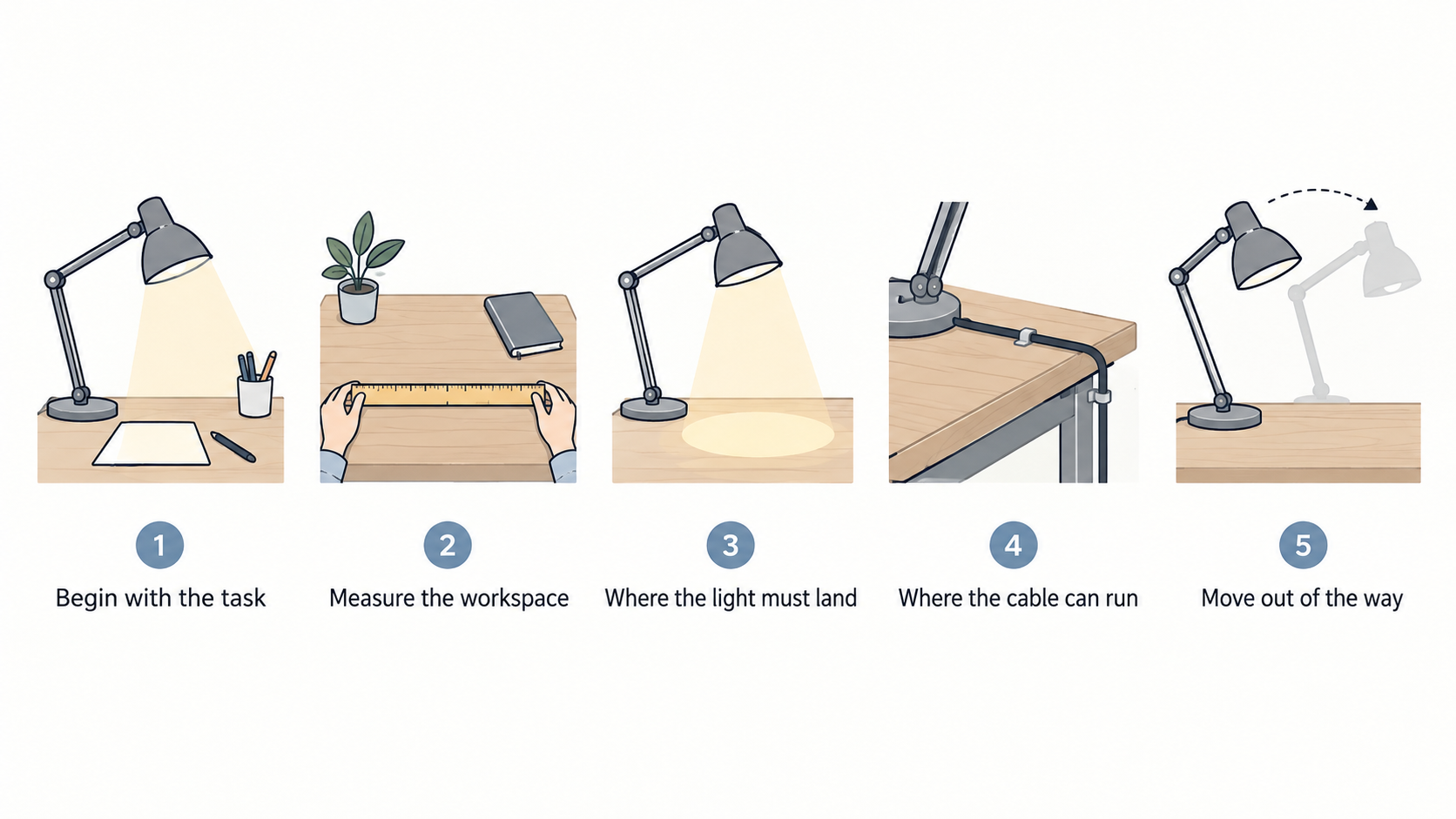
Begin with the task, then measure the workspace around it. A home-office desk, studio bench and light workshop surface can need very different lamp positions. Before comparing prices, identify where the light must land, where the cable can run and whether the lamp needs to move out of the way between tasks.
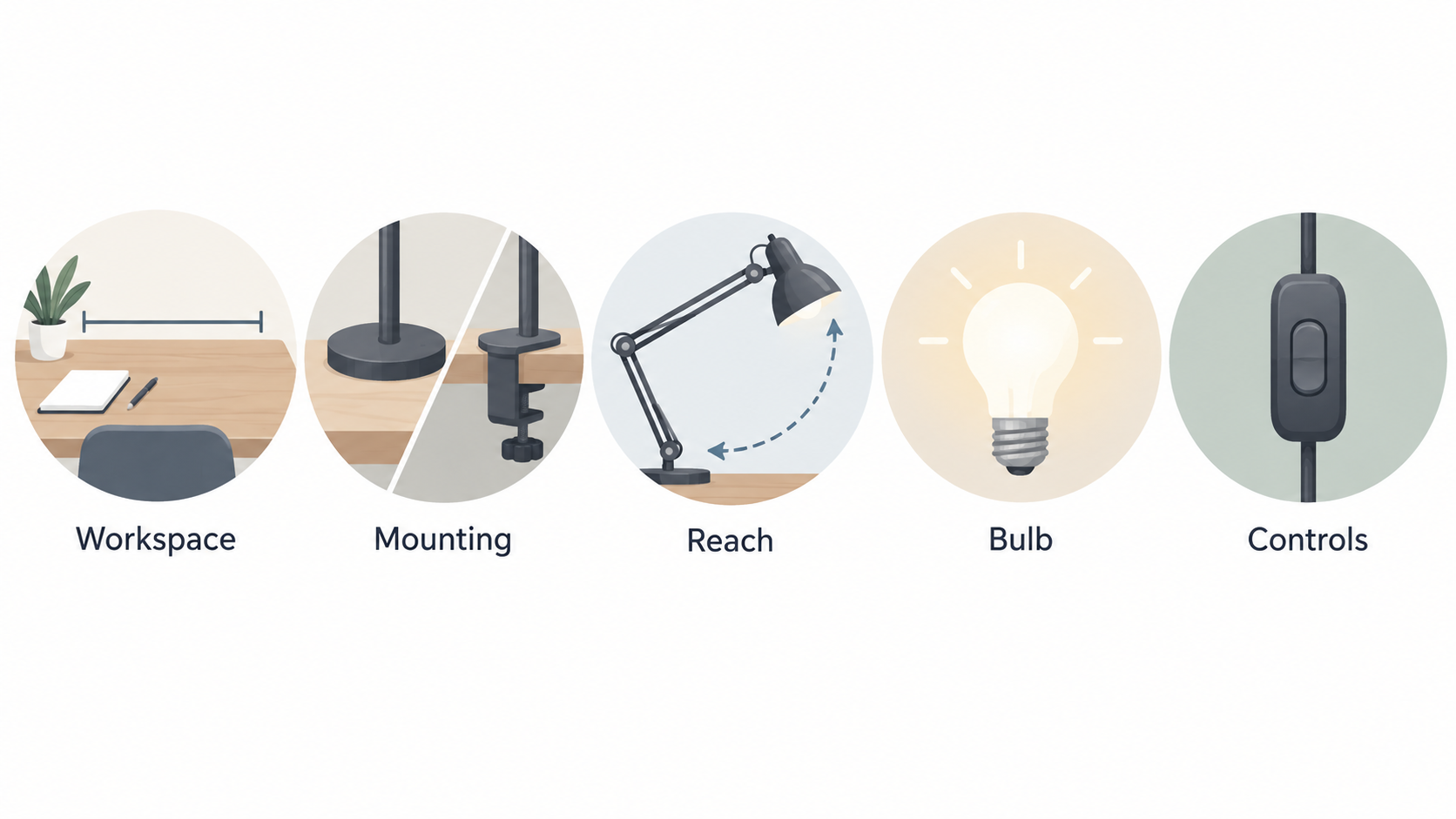
The useful comparison points are usually physical rather than promotional: the lamp’s base or mounting method, the stated reach of its arm, the movement of its head, the bulb arrangement, the switch location and the manufacturer’s documented care or service information. These details make a purchase decision more durable than a guess about a future sale.
For example, IKEA describes the TERTIAL as a steel work lamp with an adjustable arm and head, while Anglepoise describes the Type 75 as having flowing movement and full adjustability. Those descriptions establish that both products are designed to be repositioned; they do not, on their own, prove that either lamp will provide the same illumination across every desk or task. Measure your own work area before treating an adjustable design as a solution.
A simple starting note can prevent a mismatched purchase: record your usable desk depth and edge thickness, the distance from the intended mounting point to the work area, the nearest socket and any monitor, shelf or wall that could obstruct movement. If you cannot answer one of those questions yet, waiting may be more sensible than buying on timing alone.
Choose the mounting arrangement before the lamp
AI-generated illustration — not a retailer product photo.
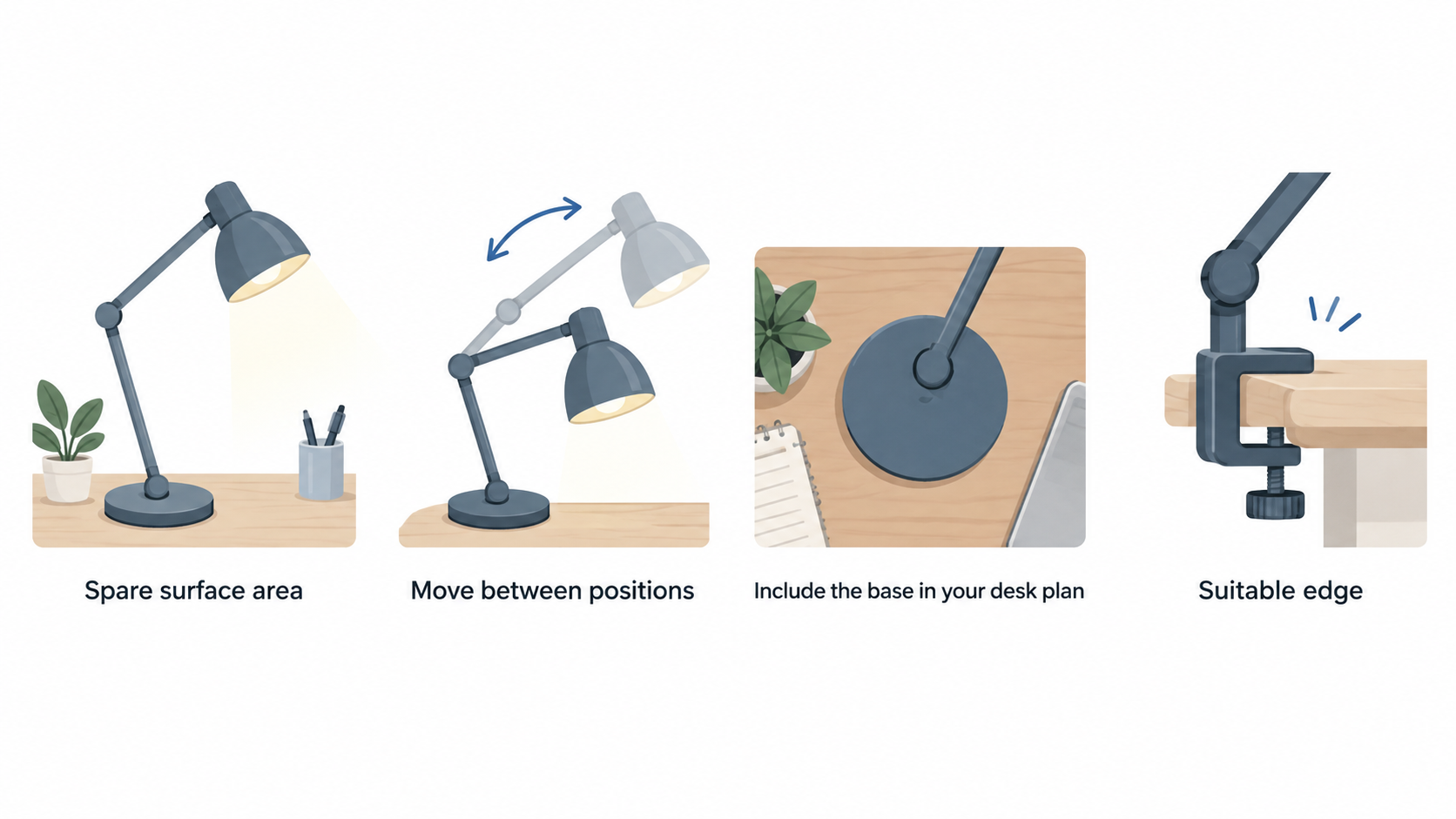
A freestanding base is often the most straightforward arrangement when you can spare surface area and expect to move the lamp between positions. It does not depend on the shape or thickness of a desk edge. The trade-off is that its footprint occupies part of the work surface, so include the base in your desk plan rather than judging the lamp by its shade alone.
A clamp-capable lamp can keep more of the main work area clear, provided the desk has a suitable edge. IKEA states that the TERTIAL’s clamping range is up to 60 mm and that the lamp can also be used as a table lamp or mounted on the wall. Treat that 60 mm figure as a product-specific check: measure the intended desk edge, including any lip, cable tray or reinforcement underneath, before assuming the clamp will fit.
A wall-mount option can be useful where the desk edge is unavailable or the lamp must remain in a fixed location. It also changes the planning question. Instead of checking the desktop footprint, check whether the wall position will let the arm and shade reach the task without conflicting with shelves, screens or storage. The supplied product information confirms that TERTIAL may be wall-mounted, but it does not determine the suitability of a particular wall or installation.
The Type 75 uses a cast-iron base with an aluminium cover and has a stated base diameter of 7.9 inches. That gives a concrete footprint dimension to compare with a desk plan. It is not a reason to prefer a base universally: choose a base when the surface space is genuinely available, and choose a clamp or wall arrangement only after the required clearance and placement have been checked.
Check reach, adjustment and desk clearance
AI-generated illustration — not a retailer product photo.
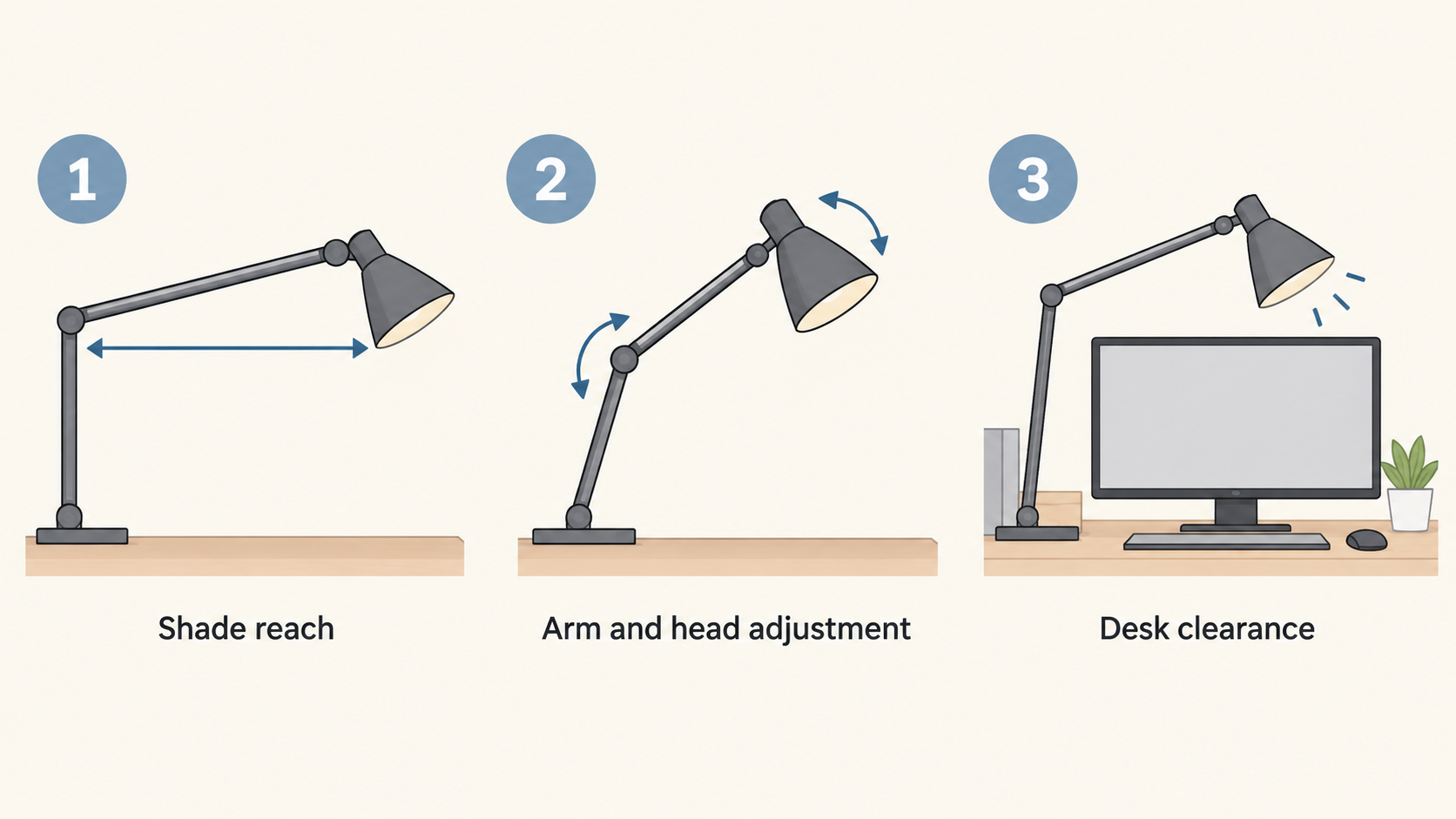
“Adjustable” is not the same as “long enough.” Separate three questions: how far the shade can reach from its mounting point, how the arm and head can be repositioned, and whether anything in the workspace will block that movement.
Anglepoise lists a maximum reach of 26 inches from the Type 75 base to the shade. Its product page also lists a 5.5-inch shade diameter, a 7.5-inch shade height and a 78.7-inch cable. Use these as planning dimensions, not promises about light coverage. A 26-inch maximum reach may be adequate for one desk layout and inadequate for another if the base must sit behind a monitor or away from the work surface.
IKEA states that the TERTIAL arm and head are adjustable and that the light can be directed where wanted. This supports using the lamp’s movement as part of a placement plan. It does not supply a universal reach figure in the provided material, so do not substitute the Type 75 measurement for TERTIAL or assume equal clearance.
Make a low-risk desk-clearance check before ordering. Mark the intended base, clamp or wall position; measure from that point to the centre of the working area; then note the tallest likely obstruction, such as a display, shelf or tool storage. Leave space for the shade to be positioned without striking those objects. Finally, trace the cable route to the socket and decide whether it can remain clear of moving chair parts and routine work.
If the measurements work only with the lamp at the end of its stated reach or with no room for adjustment, the arrangement is fragile. Waiting until the desk is reorganised, or choosing a different mounting arrangement, is usually a better decision than expecting an adjustable arm to compensate for an unresolved layout.
Confirm the bulb, controls and regional compatibility
The lamp price may not represent everything needed to use it. First establish whether a bulb is included, which base the product specifies and whether the lamp uses a replaceable bulb or an integrated lighting system. Then confirm that the version being sold in your market matches the documentation you are using.
The German IKEA TERTIAL page says that the light bulb is sold separately and recommends an LED E27 globe opal white bulb. This makes the bulb a separate purchase decision. Check the exact bulb information on the retailer page when ordering, rather than treating an E27 recommendation as a statement about every task lamp or every regional listing.
The supplied Anglepoise Type 75 page describes an E26 bulb as included and lists an integrated shade switch. That is a different documented package: the bulb is included for that listed product, and the control is placed at the shade. An included bulb can reduce the number of items needed at checkout, but it does not by itself establish future replacement cost, brightness, suitability or availability in another market.
Regional context matters here. The supplied Type 75 source is a USA product page, while the TERTIAL source is an IKEA Germany page. Compare like with like before drawing conclusions from their bulb-base terminology, delivery wording or stock status. BenQ’s supplied regional page also asks visitors to select a region for applicable content and notes that service may be unavailable in some locations, reinforcing the practical need to verify the local product page and retailer terms.
An integrated switch is useful only when it is in a convenient place for your setup. It does not tell you whether the lamp’s reach, mounting or bulb arrangement is suitable. Treat controls as one line in the checklist, alongside—not instead of—the physical measurements.
Use a total-cost framework instead of waiting for a forecast
A sensible ownership-cost comparison does not need a discount forecast. List the documented items included with each lamp, the separately required items, any delivery or return terms you need to review, care instructions and the support statement that applies to the product version and region you intend to buy.
The TERTIAL information identifies steel and ABS-plastic components and gives basic care directions: wipe with a cloth dampened in mild cleaner, then wipe dry with a clean cloth. It also says a bulb is sold separately. These are practical ownership facts to include in a comparison, but they do not predict how long a particular lamp will last or what a future bulb purchase will cost.
For the supplied Type 75 listing, the stated package includes an E26 bulb and describes an integrated shade switch, aluminium shade and arms, chrome-plated fittings, and a cast-iron base with aluminium cover. The page also presents Anglepoise’s “Guaranteed for Life” promise as a commitment to service the light so it continues to work for a lifetime. Read the applicable terms before relying on that support statement, especially when buying outside the USA listing shown here.
Use a short comparison sheet:
- What is included in the box, and what must be bought separately?
- What mounting space or desk modifications are required?
- Which care instructions can you realistically follow?
- What delivery, return and service terms apply to the exact local listing?
- If a bulb is replaceable, what must you verify before obtaining a future replacement?
Buy now when the answers are clear and the current workspace needs the lamp. Wait when a missing component, uncertain fit or unclear local support term would make the purchase speculative. This approach avoids treating an unknown promotion as the only source of value.
Make the buy-now or wait decision
Buy now if your workspace is ready and the product’s documented requirements answer the practical questions. For a clamp arrangement, that means the desk edge fits the stated clamp range; for a base, it means the footprint leaves enough working space; for either arrangement, it means the intended position can reach the task without obstructing the desk.
Also confirm the light-source package. IKEA’s TERTIAL requires a separately purchased bulb according to its German listing, whereas the supplied Anglepoise Type 75 listing includes an E26 bulb. Confirm the local version before checkout, and make sure the relevant bulb, switch and cable arrangement fit your own plans.
Wait when a required specification remains unresolved. Common reasons include an unmeasured desk edge, no safe practical place for the base, uncertainty about the local bulb specification, or a support and return policy that has not been checked for the actual seller. Waiting in these cases is not about predicting a discount; it is about avoiding an avoidable mismatch.
The final decision can be simple: if mounting, reach, bulb and local purchase conditions are confirmed, a current need is a strong reason to buy. If one of them is not confirmed, use the time to measure, compare the local listing and decide what configuration the workspace can actually support.
Frequently Asked Questions
Should I choose a desk lamp with a base or a clamp?
Choose the arrangement that fits the surface you have. A base needs usable desktop space; a clamp needs a compatible desk edge. IKEA lists TERTIAL with a clamping range up to 60 mm and says it can also be used as a table lamp or wall-mounted. Measure first, then choose the configuration that preserves the working area you need.
Does an included bulb make a task lamp cheaper to own?
It can reduce what you need to purchase initially, but it is not enough to determine overall ownership cost. The supplied Type 75 listing includes an E26 bulb, while IKEA says TERTIAL’s bulb is sold separately and recommends an E27 LED globe opal white bulb. Compare the complete local package, care needs and support terms rather than judging cost from one included item.
What should I check before buying a task lamp in Germany or elsewhere in Europe?
Check the local product listing, bulb-base information, included items, delivery and return terms, plus the fit of the mounting arrangement in your workspace. The supplied sources cover a German IKEA listing and a USA Anglepoise listing, so their regional product details should not be treated as interchangeable.
Is an integrated switch enough to compare task lamps?
No. The Type 75 product page lists an integrated shade switch, but a switch location does not replace a reach, clearance or bulb check. Compare controls alongside the lamp’s documented mounting method, dimensions, cable route and light-source arrangement.
Sources
Related reading
- Best adjustable desk and task lamps for German homes and workshops: evidence-led top choices
- IKEA TERTIAL review: clamp, reach, replaceable bulb and everyday trade-offs
- How to choose a desk or task lamp by reach, mounting, controls and light-source design
- How to spot a genuine task-lamp deal using exact model, mounting kit and ownership cost
Editorial information: About our editorial team · Read our editorial policy · Read our affiliate disclosure.