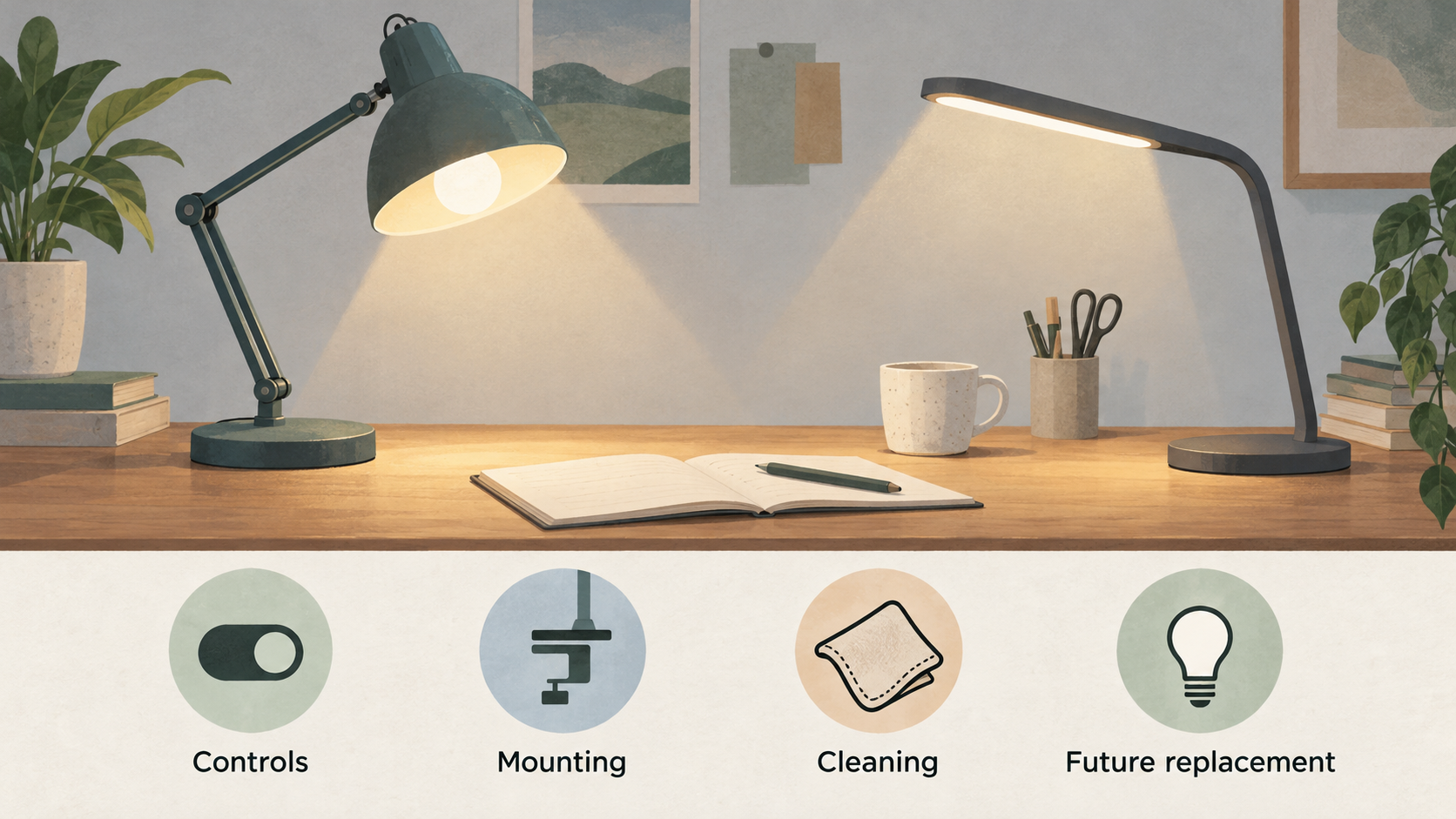
AI-generated illustration — not a retailer product photo.
A desk lamp is easier to choose when you separate two questions: how the fixture directs light, and how its light source is configured. Replaceable-bulb and integrated-LED designs can both suit focused work, but they create different checks around controls, mounting, cleaning and future replacement. The useful comparison is the exact model in front of you—not a promise that one architecture will always last longer or work better.
What This Task-Lamp Comparison Covers
AI-generated illustration — not a retailer product photo.
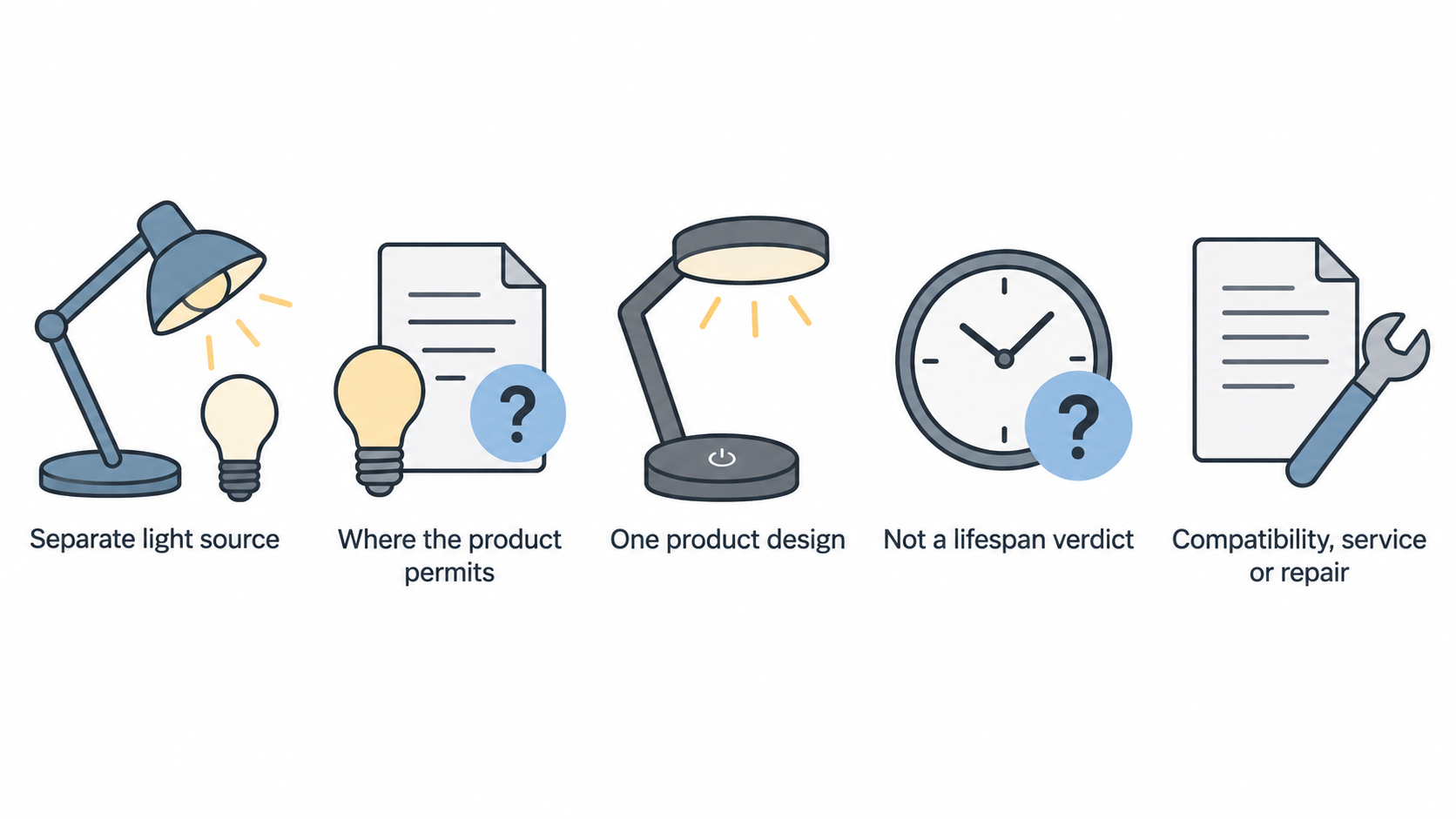
A replaceable-bulb task lamp keeps the light source separate from the fixture. When the bulb reaches the end of its service life, the buyer can investigate and, where the exact product permits it, replace that light source without replacing the whole lamp. An integrated-LED task lamp incorporates the lighting element into the fixture, so the lamp’s light distribution and any built-in controls are part of one product design.
That distinction is useful, but it is not a lifespan verdict. Product pages may document an arm, a shade, a bulb recommendation or a control feature without documenting every compatibility, service or repair outcome a buyer may care about. Treat each listing as a record of what that SKU states, then identify the information it does not state.
For example, Artemide describes the Tolomeo Table family as having an aluminium structure, an articulated spring mechanism and a head adjustable in all directions. IKEA describes its TERTIAL Work lamp as a steel design with an adjustable arm and head. These descriptions tell you to examine reach and aiming; they do not by themselves prove that either lamp is the right size, brightness or service option for every desk.
Replaceable-Bulb Task Lamps: Strengths and Checks
AI-generated illustration — not a retailer product photo.
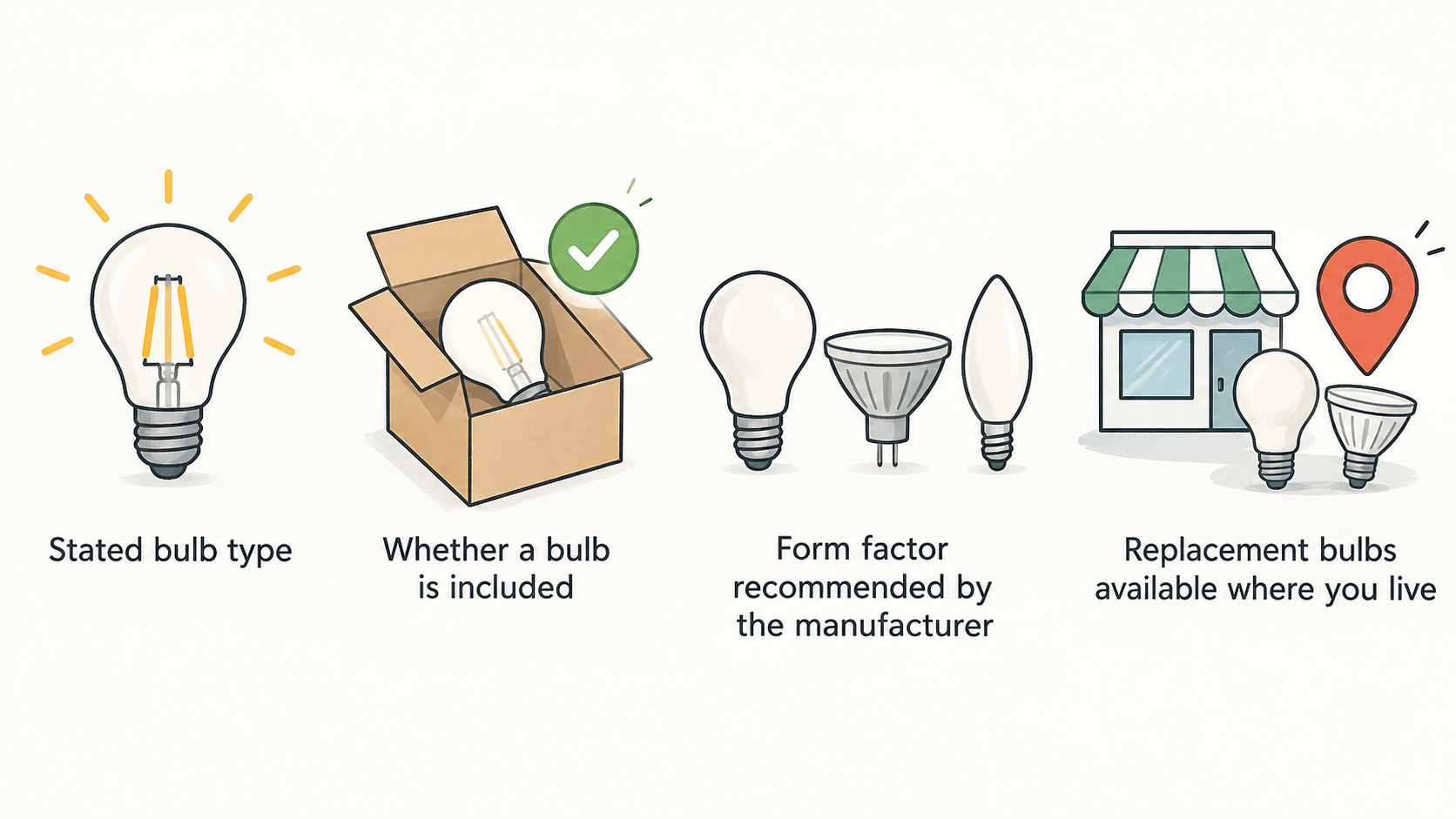
The main ownership advantage of a bulb-based task lamp is separation: the fixture and the routine light source are distinct. That can make the light-source question more visible at purchase time. You can check the stated bulb type, whether a bulb is included, the form factor recommended by the manufacturer, and what replacement bulbs are available where you live.
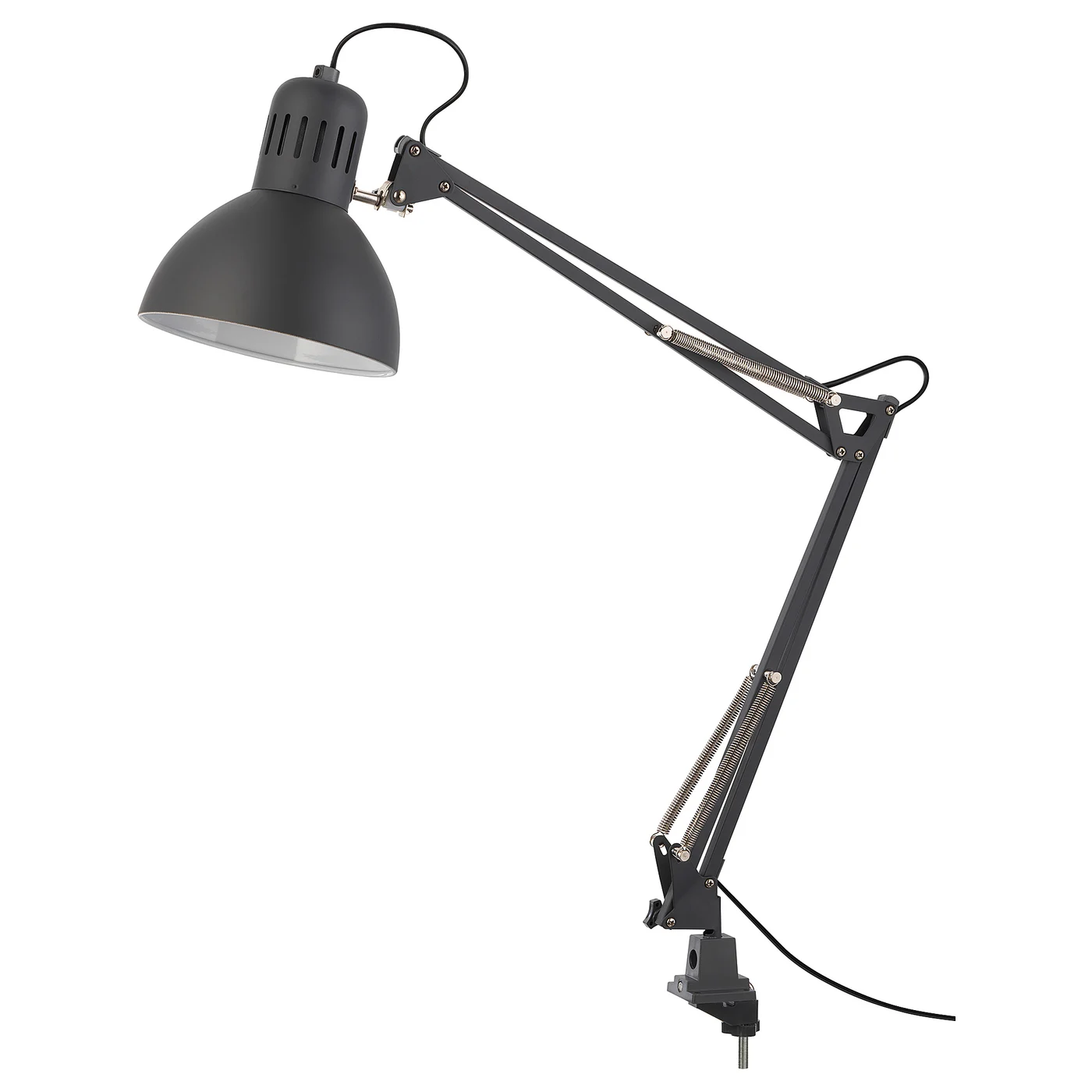
IKEA’s TERTIAL Work lamp is a useful example of the questions to ask. Its listing says that the bulb is sold separately and recommends an LED E27 globe opal-white bulb. The same page documents an adjustable arm and head, so a buyer can consider both the bulb recommendation and where the directed light will fall on the work surface.
Do not turn that recommendation into a claim of universal E27 compatibility, a guarantee about dimming, or a prediction of lamp life. Confirm the exact lamp’s instructions and the chosen bulb’s specifications before ordering. It is also worth checking access to the bulb, whether the shade suits the bulb shape you plan to use, and whether the retailer sells the relevant version in your region.
An articulated lamp can be appealing where the task moves between paper, a keyboard and a tool bench. The adjustment mechanism is a feature to assess against your own reach and clearance, rather than an automatic advantage over a smaller fixed lamp.
Integrated-LED Task Lamps: Strengths and Checks
With an integrated-LED task lamp, the light source and fixture are designed together. This can make the lamp’s physical form, aiming, controls and light distribution part of a single buying decision. Instead of choosing a separate replacement bulb, focus on the documentation for the finished product.
BenQ presents its e-Reading Desk Lamp within its lighting range. That is enough to treat it as an integrated desk-lighting product category for comparison, but the supplied product-page extract does not establish a full specification for every regional variant. Avoid filling gaps with assumptions about output, longevity, repairability or control behaviour.
Before buying, look for the exact model identifier and the manufacturer’s current documentation. Check what controls are described, how the lamp is intended to be positioned, what the warranty covers, and whether the manufacturer offers service, parts or a support route for your market. If a particular control or lighting characteristic matters to your task, confirm it in the exact product documentation rather than relying on a family name or retailer thumbnail.
This approach is not a criticism of integrated lighting. It simply keeps the relevant questions in view: what is built into this fixture, what support information is available, and does that package match the workspace you are equipping?
A Practical Comparison Matrix
Use the following matrix to compare documented facts with questions that still need an exact-SKU answer.
| Criterion | What to look for | Example of a documented detail | What not to assume |
|---|---|---|---|
| Adjustment | Arm reach, head movement and how the lamp holds position | TERTIAL is described with an adjustable arm and head. Tolomeo is described with an articulated spring mechanism and an adjustable head. | That either mechanism reaches every desk area or suits every task. |
| Mounting | Base footprint, clamp range, wall option and edge clearance | TERTIAL is documented for table use or wall mounting, with a clamping range of up to 60 mm. | That your desk edge, wall surface or accessories are compatible. |
| Light-source design | Separate bulb or integrated lighting, plus exact stated specification | TERTIAL’s bulb is sold separately; IKEA recommends an E27 LED globe opal-white bulb. | Universal bulb, dimmer or regional electrical compatibility. |
| Materials and care | Construction, finishes and cleaning instructions | IKEA lists steel parts and advises wiping with a cloth dampened in a mild cleaner, then drying with a clean cloth. | Scratch resistance, workshop durability or maintenance intervals not stated by the maker. |
| Controls and support | Built-in controls, warranty, service and parts information | An integrated product should be assessed through the exact model’s manufacturer documentation. | Future repair availability or long-term reliability. |
The matrix is deliberately not a scorecard. A listing with fewer details is not necessarily a worse product; it is a prompt to obtain more information before making a decision. Keep the distinction between manufacturer-described design attributes and independently tested performance clear.
Match the Lamp to Your Workspace
 Start with the desk, not the product category. Measure usable depth, identify where the light needs to land, and note whether a base would consume valuable surface area. Then check the available edge clearance if you are considering a clamp, or the intended wall position if you are considering a mounted lamp.
For a compact home office, a clamp-mounted articulated lamp may be worth investigating when the desk edge can accept it and the arm can reach the task area without obstructing a screen. IKEA documents TERTIAL’s clamp range as up to 60 mm and states that it can be used as a table lamp or mounted on the wall. Those are placement facts to compare with your furniture, not installation advice.
For a studio or light workshop, map the activity first: drawing, close reading, computer work and detail tasks may place the working area in different positions. An adjustable head can help you aim light toward that area, while a long arm needs room to move. The Tolomeo family’s documented articulated arm and all-direction adjustable head illustrate why mechanism and reach should be checked together.
If the lamp must frequently change position, prioritise the documentation for adjustment and mounting. If it will remain in one place, a simpler footprint and a clearly documented light-source arrangement may matter more.
Limits of the Evidence and Pre-Purchase Checks
The available product descriptions do not establish product lifespan, electrical safety for a particular installation, output adequacy for your individual task, current stock, regional price, future repair availability or the availability of every spare part. They also do not substitute for the manufacturer’s instructions or local requirements.
Before ordering, confirm the exact model and market version. For a bulb-based lamp, check the stated bulb specification, whether the bulb is included, and any relevant product instructions. For a clamp or wall-mounted option, check the mounting method, accessories and the physical dimensions of your intended location. For an integrated lamp, check the exact control description, warranty terms and manufacturer support or service channel.
Treat materials and adjustment statements as manufacturer descriptions of the product. IKEA documents steel construction and a specific cleaning method for TERTIAL; Artemide describes Tolomeo’s aluminium construction and articulated mechanism. Those facts can inform your shortlist, but they are not independent durability testing.
Finally, confirm current availability and pricing with the relevant regional retailer or manufacturer. These details can change and should not be inferred from a general comparison guide.
Choose by Ownership Priorities
Choose a replaceable-bulb design when your priority is to evaluate and potentially change the light source separately from the fixture, and the exact product documentation supports the bulb you intend to use. It can also be a practical path when a clearly stated bulb format and local replacement availability matter to you.
Choose an integrated-LED design when you prefer the light source, fixture form and built-in controls to be considered as one package—and the exact model’s documentation provides enough information about those features and manufacturer support.
For either category, put workspace fit ahead of labels. A clamp range, wall-use option, arm mechanism, head adjustment, materials and care instructions are all concrete items that may affect ownership. No category wins universally: the better choice is the one whose documented configuration matches your desk, task, maintenance preference and support expectations.
Frequently Asked Questions
Are replaceable-bulb task lamps easier to maintain?
They can separate routine light-source replacement from the fixture, but “easier” depends on the exact model, bulb access and stated bulb specification. IKEA’s TERTIAL listing says the bulb is sold separately and recommends an E27 LED globe opal-white bulb. Confirm the instructions for the specific lamp and bulb rather than assuming every bulb-based lamp works the same way.
What should I check before buying an integrated-LED desk lamp?
Check the exact model’s documented controls, intended positioning, warranty and manufacturer support or service information. The supplied BenQ material identifies the e-Reading Desk Lamp as part of its lighting range, but it does not support broad conclusions about every specification or future repair option. Obtain current documentation for the model and region you intend to buy.
Can an adjustable desk lamp be mounted with a clamp or on a wall?
Some can, but the mounting method is model-specific. IKEA states that TERTIAL can be used as a table lamp or mounted on the wall, and documents a clamp range of up to 60 mm. Compare that with your desk edge, wall location and the product’s instructions before ordering.
Which lamp details should I confirm before ordering in Germany or elsewhere in Europe?
Confirm the exact regional model, current availability and price, light-source information, mounting accessories, warranty and the manufacturer’s support route. If the lamp uses a replaceable bulb, verify the stated bulb recommendation; if it has integrated lighting, verify the product’s documented controls and service information. General product descriptions should not be treated as safety, medical-suitability or future-repair guarantees.
Sources
Related reading
- Best adjustable desk and task lamps for German homes and workshops: evidence-led top choices
- Anglepoise Type 75 vs Artemide Tolomeo: reach, mounting, light source and repair paths compared
- BenQ WiT e-Reading desk lamp review: wide coverage, controls and ownership trade-offs
- How to choose a desk or task lamp by reach, mounting, controls and light-source design
Editorial information: About our editorial team · Read our editorial policy · Read our affiliate disclosure.